
The US on Friday issued orders to ban popular Chinese social media apps TikTok and WeChat from Sunday to safeguard national security, weeks after India banned them, saying they were prejudicial to sovereignty, integrity and security of the country.

China will resolutely safeguard its border sovereignty in conflicts with Indian troops even at the cost of war, GT said.

With his eye on next year's Party Congress, Xi Jinping is using the CCP's centenary celebrations to publicise the benefits for China from its leadership, and boost his image and contribution to China's rise, observes Jayadeva Ranade, the distinguished China expert and retired RA&W officer.

India needs to take note of China's assertiveness in implementing its national security law as also its recently exhibited sensitivity to criticism of Xi Jinping by the Indian media, says former senior R&AW officer and China expert Jayadeva Ranade.

'There are reports of political dissent mounting on Xi Jinping's handling of the Wuhan fallout.'

Support from the committee gives Xi an indefinite extension on the reins of power, which will surely result in hawkish and insular policies. It does not bode well for relations with the USA, or with anyone else who does not bow the knee to Beijing, for that matter.
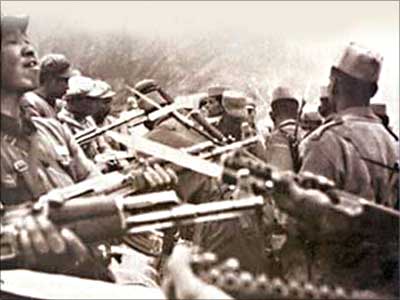
From March 1959 to March 1962, the PLA fought 12 major battles in central Tibet which was seen as an opportunity to train China's soldiers, notes Ajai Shukla.
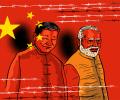
The reasons for China's negative response are located in its territorial dispute with India but also to its grand designs of dominating the region from its previous position of being merely a "balancer" between India and Pakistan, points out Srikanth Kondapalli, Professor in Chinese Studies at JNU.

US rate hike fear keeps Asian firms in check; India most upbeat.

Dr Manmohan Singh would be faced with very few choices in Beijing given the Chinese conceived notions of the world today and India's low place in their calculus, says Srikanth Kondapalli.

A solution to motion leaks would be to lower the sample rate of the sensors

In anticipation of a verdict to be delivered by the International Tribunal of the Permanent Court of Arbitration in The Hague on Tuesday, China has orchestrated a worldwide campaign to defuse its findings.
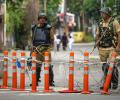
'India needs to closely monitor the discussions at the UNSC and make counter-measures as this touches its core interests', points out Srikanth Kondapalli.
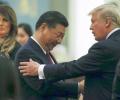
'While many Chinese policy makers dismiss the political, economic and technological component of US-India relations, they express caution on the defence-related ties which also happens to be a major driver in US-India relations,' explains China expert Srikanth Kondapalli.

This is a high-stakes strategic conflict between a power which wants to preserve the status quo in its favour and one which wants to usurp that throne. The rest is all theatre, says Harsh V Pant.

'From Doklam to Wuhan and the return of the India-China relationship to its previous equilibrium is indeed a major contribution of President Xi and PM Modi. Without any doubt they deserve the kudos for their sagacity and their wisdom,' says Ambassador Gautam Bambawale, India's envoy to China during the Wuhan summit.

Donald Trump is believed to be the first US President or President-elect to have spoken to a Taiwanese leader since 1979, when the US severed diplomatic ties with Taiwan after its recognition of the People's Republic of China, points out former RA&W officer Jayadeva Ranade.

'In the run-up to the summit, Trump had indicated that he might strike a nuclear deal in the course of a single meeting or over several days, but as it transpired, Trump departed Singapore soon after the meeting.' 'This raises questions if his aspirations for an ambitious outcome had been scaled back,' says Rajaram Panda.

The Wuhan meetings signify an incremental shift in China's position on India as well as each country buying time for the next phase of bilateral relations, says Srikanth Kondapalli.

'Xi's emphasis on enhancing conventional military deterrence capabilities, joint operations and power projection are likely to increase friction points with India as with other nations,' points out China expert Srikanth Kondapalli.
'The boundary dispute notwithstanding, China has always had leaders who have been, on the whole, positively disposed towards India.' 'Given the centrality of the Chinese Communist Party, we need to strengthen the linkages with the crucial personalities in the highest echelons of the Communist party and political leadership,' notes China expert Alka Acharya.

'Without it, it is going to be much, much, much, much worse.' 'In the meantime, we really need to work on a sort of war footing, given that it is a natural disaster, provide relief, provide essentials, till we get biological herd immunity, we need to get economic immunity, and also social immunity.'

'Does it mean that we are witnessing the end of an era?' 'Probably not, but the post-Trump trade war has certainly brought a lot of instability in China,' notes Claude Arpi.
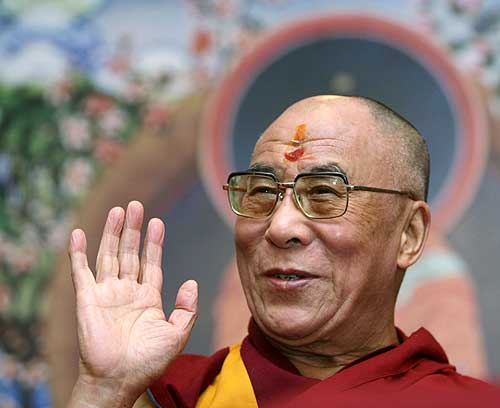
'The first time that China alleged the Dalai Lama was 'anti-national' and 'unpatriotic' was after he affirmed that Arunachal Pradesh and Tawang are part of India,' points out former RA&W official Jayadeva Ranade.

Modi also said the people of India felt proud that President Xi has twice received him out of the capital.

'While visits and personal meetings are useful, changes of strategic significance have occurred recently, with Beijing trying to take the lead which Modi must take note of.'
At scaling back Tehran's nuclear programme and relieving the Islamic Republic from the sanctions

'Extending the range of the DF-21D could challenge Indian aircraft carriers if the missiles are launched from southwest China. Also, if Pakistan acquires these systems, these missiles could directly challenge India's aircraft carriers.'

All the three issues raised by China at the Modi-Xi meeting are either intractable or peripheral to the bilateral relations and suggest conventional methods to placate the other side without yielding much, says Srikanth Kondapalli.

No Indian auto brand (including Tata or Mahindra) is well-known globally.

China has relaxed its one-child policy and further freed up markets in order to put the world's second-largest economy on a more stable footing.

China is spending billions of dollars to improve infrastructure in Tibet and other parts of its border with India. Claude Arpi explains why New Delhi can't afford to ignore Beijing's plans.

'If, as appears to be the case, India is on way to 'mending fences' with China, and China is equally desirous to 'reset' the relationship, this could be a self-reflexive moment in India's positioning vis-a-vis not just the Dalai Lama, but also the Tibetan issue and China as a whole,' points out China expert Alka Acharya.
'India and China have to make concrete progress with regard to the border issue, addressing the trade deficit, and facilitating people-to-people interactions. This has to happen in the next two, three years.' China expert Tansen Sen tells Sheela Bhatt/Rediff.com how India and China can take their relations to the next level.
